
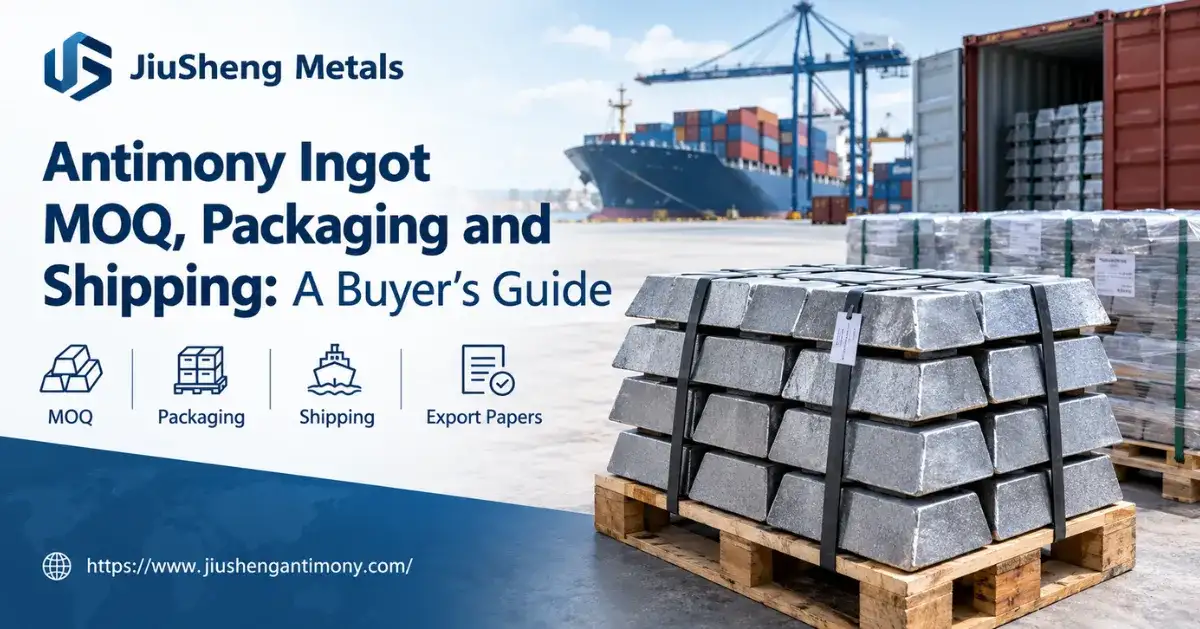
Imagine you place an antimony ingot order, and then the surprises start. The supplier says your quantity is too small. The ingots arrive loose and hard to count.
The shipping terms turn out to cover less than you thought. Each surprise costs you time and money.
These problems are easy to avoid if you ask the right questions first. You need to know the smallest amount you can order, how the ingots are packed, and who pays for each step of shipping. Without these facts, even a good price can turn into a bad deal.
In this blog, we explain MOQ, packing, shipping terms, and export papers in simple words. We also give you a short checklist to use before you order.
MOQ means minimum order quantity. It is the smallest amount a supplier will sell you in one order. If you ask for less, the supplier may say no.
Suppliers set an MOQ because every order has fixed costs. Testing, packing, and paperwork take about the same effort for a small order as for a large one.
Jiusheng Metals runs a factory in Pailin, Cambodia, with a production capacity of over 600 tons per month. Even so, the MOQ can change with the purity, size, and weight you choose.
Here is what can change your MOQ:
Always ask for the MOQ in writing. Also ask if it is counted in tons, pallets, or containers.
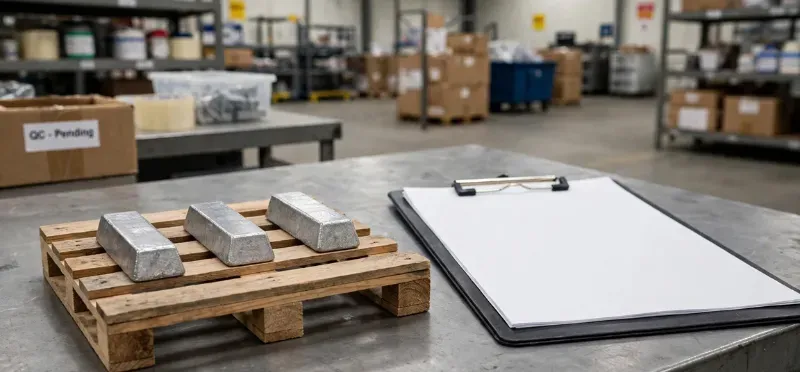
A trial order is a small first order. You use it to test the ingots, the packing, and the service. A bulk order is a large order for steady supply.
They work best once a trial batch has passed your own tests. Many buyers start small and compare the first batch to its certificate. Then they move to a bulk antimony ingots order.
You can also ask Jiusheng Metals for samples first. Samples are available on request, so you can test the metal before a bulk order.
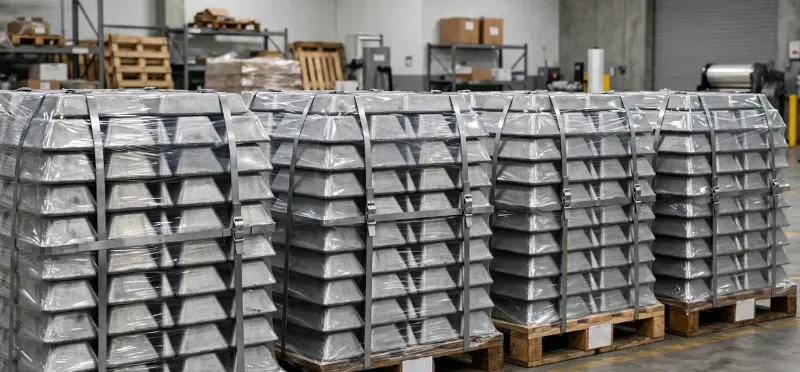
Antimony ingots are solid metal bars. They are heavy, so good packing matters. Good packing keeps them safe, easy to count, and easy to trace.
The standard Jiusheng Antimony ingot is trapezoidal. That means the top is wider than the base.
The base is 17 cm wide, the top is 23 cm wide, and the height is 11 cm. You can also discuss the weight per ingot that you need.
Metal ingots are usually packed for export in a few simple steps:
These steps are common in the trade.
Key takeaway: Agree on the MOQ, the packing, and the shipping terms in writing before you pay.
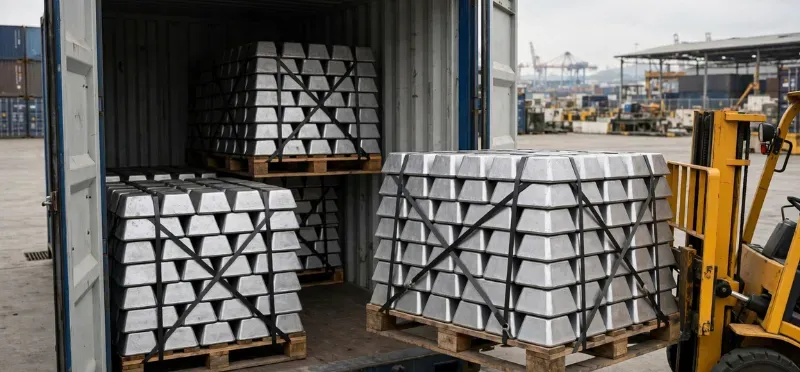
Shipping terms tell you who pays for each step and who carries the risk. They are often called Incoterms, which is short for international commercial terms. Two common ones are FOB and CIF.
FOB means Free On Board. The seller pays to bring the goods to the port and load them on the ship. After that, you pay for the sea freight and insurance, and the risk is yours.
CIF means Cost, Insurance, and Freight. The seller pays to ship the goods to your destination port and buys basic insurance. The risk still passes to you once the goods are on the ship.
FOB gives you more control over the ship and the freight price. CIF is simpler if you want the seller to arrange the voyage. Under both terms, you usually pay import duties and local fees.
Ask for both quotes and compare the total cost at your door. Also ask for the port of loading and the lead time, and get both in writing.
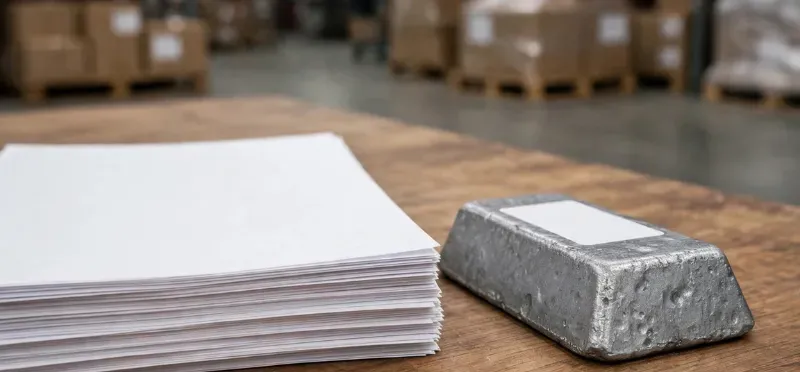
Papers show what is in your shipment and what you agreed to buy. Missing or wrong papers can hold up your cargo at the port.
| Item | What it is | What to check |
| Certificate of analysis (COA) | A lab report on the purity of the batch | Purity, batch number, and test date match your order |
| Packing list | A list of what is on each pallet | Counts and weights match the labels |
| Commercial invoice | The bill for the goods | Price, quantity, and FOB or CIF terms match your contract |
| Bill of lading | The receipt and contract from the shipping line | Names, ports, and goods are correct |
| Safety data sheet (SDS) | A guide to safe handling | It names the right material |
Jiusheng Metals ingots have purity above 99.65%, and the standard ingot is tested at 99.88%. Batch traceability and a certificate of analysis are available on request. Always compare the COA with the batch number on the label.
To learn more about grades, read why purity levels matter for buyers.
Use this list before you say yes to any order:
Need to review the supplier too? Use our 7-point supplier checklist to compare your options.
MOQ is the smallest order a supplier will accept. Packing keeps your ingots safe and easy to check. FOB and CIF decide who pays for each shipping step.
Papers like the COA prove what you received. Agree on all of these in writing, and start with a trial order if you are new to a supplier.
MOQ means minimum order quantity. It is the smallest amount a supplier will sell in one order. Always ask for it in writing.
Many buyers start with a trial order to test the ingots and packing. Jiusheng Metals also offers samples on request, so you can test the metal first.
Ingots are usually stacked on pallets, strapped, wrapped, and labeled with batch details.
With FOB, the seller pays until the goods are on the ship, and you pay the freight. With CIF, the seller also pays the sea freight and basic insurance to your port.
Common papers are the COA, packing list, commercial invoice, and bill of lading. Batch traceability and a COA are available on request from Jiusheng Metals.
It depends on the route, the port, and the shipping method. Ask your supplier for the lead time for your route, and get it in writing.
Ready to plan your order? Please request a quote from Jiusheng Metals by sending your quantity, purity, and destination. With over 30 years of experience in the antimony industry, our team can share MOQ, packing, and shipping details for your order.
Many bulk antimony buyers make a costly mistake: they focus on the price per ton before confirmin...
READ FULLImagine you place an antimony ingot order, and then the surprises start. The supplier says your q...
READ FULLChoosing an antimony ingot supplier based on price alone can create costly problems for your supp...
READ FULL

Have a question or need a quote? Fill out this form and our team will get back to you quickly!
