
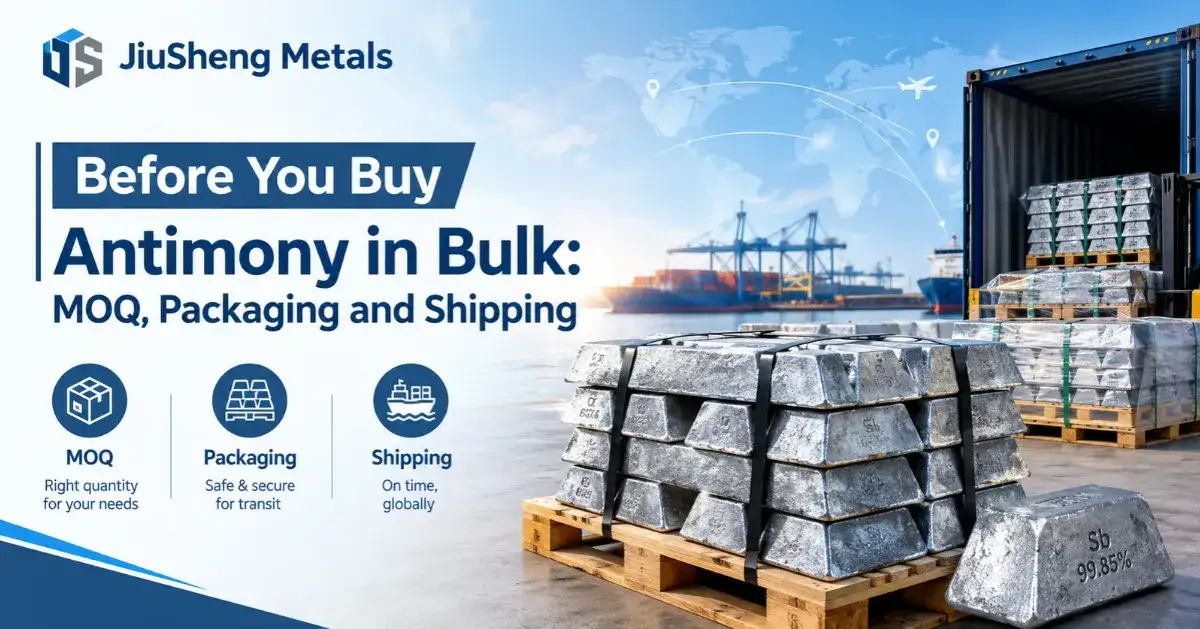
Many bulk antimony buyers make a costly mistake: they focus on the price per ton before confirming if the order quantity and delivery terms fit their production needs. A low quotation becomes useless when the ingots fail to meet chemical specifications. If the bulk order is more than what is needed, it ties up working capital. The problem is not always the supplier's price. It is what the deal leaves out. You may belong to any industrial sector that needs antimony as a raw material, but the top priority remains the same regardless of industry: it needs to match purity, packaging, and export documentation before you even consider the price. That is why a reliable procurement decision begins with technical fit, not price alone. Get the specification right first. Then compare suppliers, order quantities, and landed costs.
| Procurement criterion | Sb 99.85% grade | Sb 99.65% grade |
| Antimony content | Minimum 99.85% | Minimum 99.65% |
| Potential applications | High-purity alloy production and battery-related uses, subject to process specifications | Industrial alloys and other applications that accept this purity |
| Trace element controls | Define individual limits for As, Pb, and Bi | Define individual limits for As, Pb, and Bi |
| Purchasing priority | Tighter chemistry control and consistent batch quality | Application suitability and overall cost efficiency |
Not sure which grade fits your process? Read our guide on how purity levels affect buyers before you write your specification.
In industrial buying of antimony, having a clear idea about order size is the first thing you should know so that you commit capital according to your budget. Ordering the right quantity also means you get a suitable unit price that is efficient to transport. The right quantity is the one your factory can use economically, not necessarily the largest quantity your supplier is willing to sell. If you are comparing bulk antimony ingots for a new production line, start with your monthly usage and work backward to a practical order size.
Direct smelter purchases commonly involve full-container quantities. As an initial planning benchmark, expect approximately 20 to 25 metric tons (MT) as the actual MOQ if you are opting for direct smelter purchasing. This is not fixed, and the MOQ will vary slightly depending on the producer, origin, available stock, and shipping arrangements. Regional distributors offer smaller lots of around 1 to 5 MT. This can be useful when you are testing a supplier, or you operate a smaller production line. The trade-off is price. Distributors may charge a premium to cover storage, handling, and the cost of breaking bulk shipments into smaller orders.
When comparing the minimum order quantity for antimony ingots, look beyond the quoted price per ton. A full container reduces unit costs but will lock up your working capital for months if the consumption rate is slow. Placing smaller orders means the per-ton cost becomes higher, but on the upside, inventory pressure is low. Choosing between direct smelter purchase and distributor order comes down to your production schedule and plant size. Here, carefully assessing your own business model is crucial.
Spot purchases are another antimony metal sourcing model worth considering. This allows you to buy according to immediate demand without committing to future volumes. This type of bulk purchasing works well when your consumption fluctuates a lot, or you need to cover a short-term production requirement. However, spot purchasing has its drawbacks, as the buyer remains exposed to price movements and uncertain availability when the market tightens.
Long-term offtake contracts offer more planning flexibility for bulk buying. This procurement method offers recurring quantities with delivery schedules and pricing formulas that suit different kinds of production pace.
If you are choosing this sourcing strategy, you need to clearly define the pricing formula precisely. Your contract should specify the price assessment used, quotation period, appropriate currency conversions, and any agreed premium. If these terms are vague, both parties may interpret the same pricing clause differently. Choosing between spot purchase vs. long-term contract antimony ingots is influenced by two things: your consumption pattern and risk tolerance. If antimony is a raw material vital for continuous production, supply continuity will matter more than getting the lowest short-term price, and for that, a long-term contract is definitely the better choice.
You can get the highest quality antimony ingots and still run into problems if the packaging is of low quality. This is because you will be receiving damaged ingots, which will complicate receiving operations and trigger disputes with suppliers or freight providers.
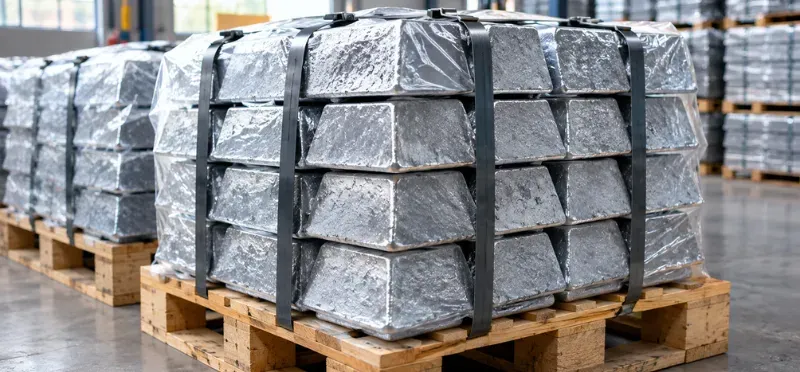
A standard export configuration uses ingots weighing approximately 25 kg each. These ingots are grouped into bundles of around 1,000 kg, or 1 MT. Heavy-duty steel bands secure the bundles for lifting and transportation. But this packaging format varies since actual ingot dimensions and bundle weights vary by producer. When bulk ordering ingots, it's your job to get the details in writing before approving the shipment. If your plant needs a different ingot weight or size, ask about customized antimony ingots before you place the order.
Your purchase order should state the individual ingot weight and the net metal weight per bundle. Other details it should mention are gross package weight, packaging method, and number of bundles. Ask for photographs or a packing diagram if you are sourcing from a new supplier. Getting the right detail is a small step that prevents a receiving problem later.
When comparing antimony ingot bundle weight and pallet specifications, establish whether the supplier's quotation includes pallets, protective wrapping, and any required export packaging. These additional costs should not appear as surprises after you have agreed on the metal price.
Some suppliers ship palletized bundles. Others use wooden crates or alternative packaging systems. The appropriate packaging format entirely depends on cargo weight, shipping conditions, and destination-country regulations. From your end, you should be aware of such laws and regulations before committing to a bulk order.
If your order involves antimony ingot wooden crate export packing standards, you need to ask the supplier to confirm compliance before loading. Many destinations impose specific packaging requirements. If the packaging is non-compliant, it can result in inspections, delays, or fines.
Also clarify who pays for the packaging. A quotation that excludes export crates or pallet treatment may look cheaper than a competing offer but deliver a higher final cost.
Antimony is relatively brittle, so rough handling can chip ingot edges, particularly when bundles are dropped. During the order placement phase, it is your responsibility to communicate to the supplier to use suitable lifting equipment during order handling.
Moisture is another factor from which you need to protect your antimony shipment. To counter moisture, protective wrapping is suitable as it reduces exposure to moisture and contamination. Desiccants can help where condensation is a realistic risk, but they are not a substitute for dry storage and sound packaging design.
At your facility, store ingots in a dry, well-ventilated area with adequate floor load capacity. In bulk ordering, you need to be extra careful about handling errors like broken bands, damaged pallets, water exposure, and visible handling damage. In case of any discrepancy, always document immediately and inform us of the problems before the antimony material enters production.
Freight charges have a significant impact on the final quote in bulk antimony purchasing. A supplier with an impressively low FOB price will not offer the best landed cost once transportation, port charges, customs clearance, and inland delivery are included.
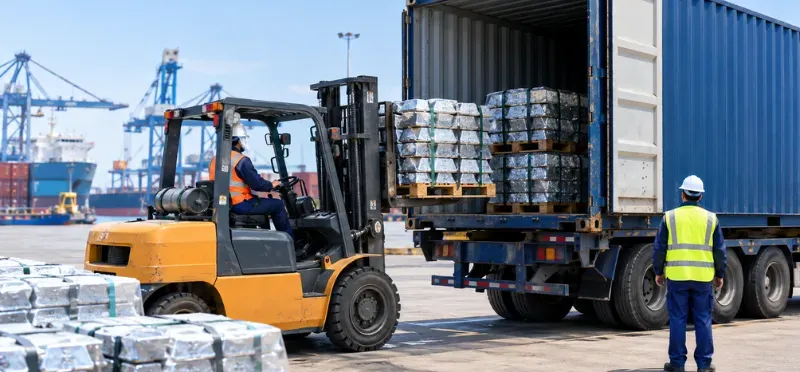
As a bulk raw material buyer, if you are sourcing full container loads, you need to ask adequate qualifying questions. Before confirming your order, ask your freight forwarder to verify the container's maximum payload and the applicable road-weight and axle limits at both ends of the route.
Another vital thing to calculate correctly is the antimony ingot container load capacity for a 20ft FCL. For doing this calculation, you need to add the net metal, packaging, pallets, dunnage, and other cargo materials into the gross weight. The antimony supplier will either quote net or gross metric tons. You need to be sure which one they are quoting. A small misunderstanding here can distort your entire freight comparison.
| Incoterm | Seller's main responsibility | What you need to manage | Suitable purchasing situation |
| FOB | Export clearance and delivery on board the vessel at the named port of shipment | Main carriage, insurance if desired, import clearance, and destination costs | You have established freight relationships |
| CIF | Export clearance, main carriage, and required minimum insurance cover | Import clearance, duties, destination charges, and onward delivery | You want a combined product and ocean-freight quotation |
| DDP | Delivery to the named destination with import clearance and applicable duties handled by the seller | Receiving arrangements and unloading where allocated to you | You need a more comprehensive delivery arrangement |
A competitive price quote is only useful if the antimony supplier can deliver the material legally and also prove that the cargo meets your specifications. This is particularly important when buying critical minerals from jurisdictions with export controls or licensing requirements.
Before making any advance payment, you need to do some verification of the supplier's legal existence. Do a background check to establish the country of origin, producer identity, destination requirements, and applicable export controls. This is important because licensing requirements vary by jurisdiction, destination, end user, and intended use.
For example, China introduced export licensing controls for specified antimony-related products in September 2024. That introduces a complication for those who are sourcing Chinese-origin material. They will need to verify the current requirements with the supplier and trade authorities. Your customs documentation requirements should include the commercial invoice, packing list, bill of lading, and certificate of origin where applicable.
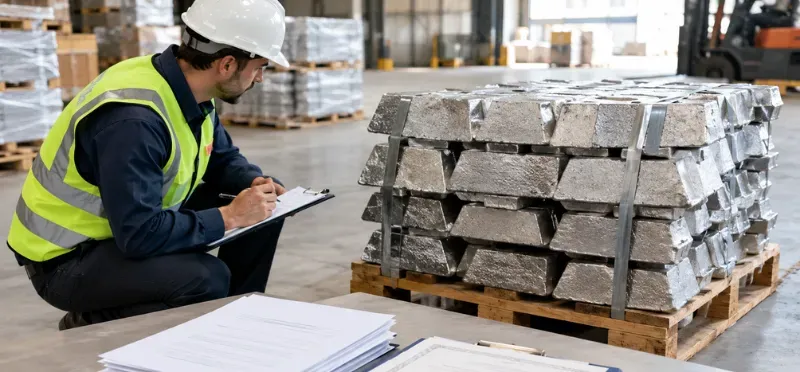
A supplier's stated purity is not enough. For a certificate of analysis for antimony ingot bulk purchase, require a COA consisting of the following details: the agreed grade, production batch, and relevant chemical test results for purity. For a high-value shipment, consider an independent inspection by a qualified organization such as SGS or Alfred H Knight. The cost and scope of testing and inspection should be specified by you before loading. Lastly, make sure the final COA documents match the shipment.
Bulk ordering antimony as a raw material comes with many challenges. So industrial buyers need to strictly follow procedures and protocols that we outlined in this blog to eliminate all risks. Submission of a precise RFQ protects your budget, supports production planning, and gives you a stronger basis for securing dependable bulk antimony supply.
Depends on where you buy. Go straight to a smelter, and you're probably looking at 20 to 25 metric tons, about one full container. Distributors sell smaller lots, often 1 to 5 tons. Handy if you're testing a new supplier. But yes, you'll pay more per ton. And none of these numbers is carved in stone. Stock, origin, and shipping plans can shift them, so ask for the MOQ in writing before you start comparing prices.
Don't just grab the higher number. Ask what your process actually needs. If you're making high-purity alloys or working on battery-related uses, 99.85% is the safer bet. For regular industrial alloys, 99.65% may do the job and keep your costs down. Either way, get limits on arsenic, lead, and bismuth into the spec. Purity percentage alone can hide a lot.
Most commonly, you'll see ingots of about 25 kg, strapped into bundles of roughly 1,000 kg with heavy steel bands. Some suppliers ship on pallets, some in wooden crates. It really does vary by producer. So don't assume anything. Write the ingot weight, bundle weight (net and gross), and bundle count on your purchase order. Buying from someone new? Ask for photos or a packing diagram. And check if pallets and wrapping are in the quote, because those costs love to show up late.
I wish there was one clean number. There isn't. The limit comes from the container's payload, the weight of pallets and dunnage, and the road and axle limits at both ends of the trip. Also, find out if your supplier quotes net or gross tons. It sounds small, but it can wreck your freight comparison. Have your forwarder check the figures before you confirm anything.
It's about how much of the shipping you want on your plate. If you already work with freight partners you trust, FOB makes sense. CIF puts the product and ocean freight in one quote and adds minimum insurance. DDP is the easy road, since the seller deals with import clearance and duties. Just don't judge by price per ton alone. A cheap FOB quote can look great right up until port charges and inland delivery land on your desk.
Buying antimony shouldn't feel like a guessing game. Nail down your grade, packaging, Incoterm, and paperwork first. The price conversation gets much simpler after that. Once your spec is ready, send your RFQ to Jiusheng Antimony with the grade, quantity, and delivery terms you need. Have questions before that? Ask away. We'd much rather answer them now than have you find a surprise at the port.
Many bulk antimony buyers make a costly mistake: they focus on the price per ton before confirmin...
READ FULLImagine you place an antimony ingot order, and then the surprises start. The supplier says your q...
READ FULLChoosing an antimony ingot supplier based on price alone can create costly problems for your supp...
READ FULL

Have a question or need a quote? Fill out this form and our team will get back to you quickly!
