
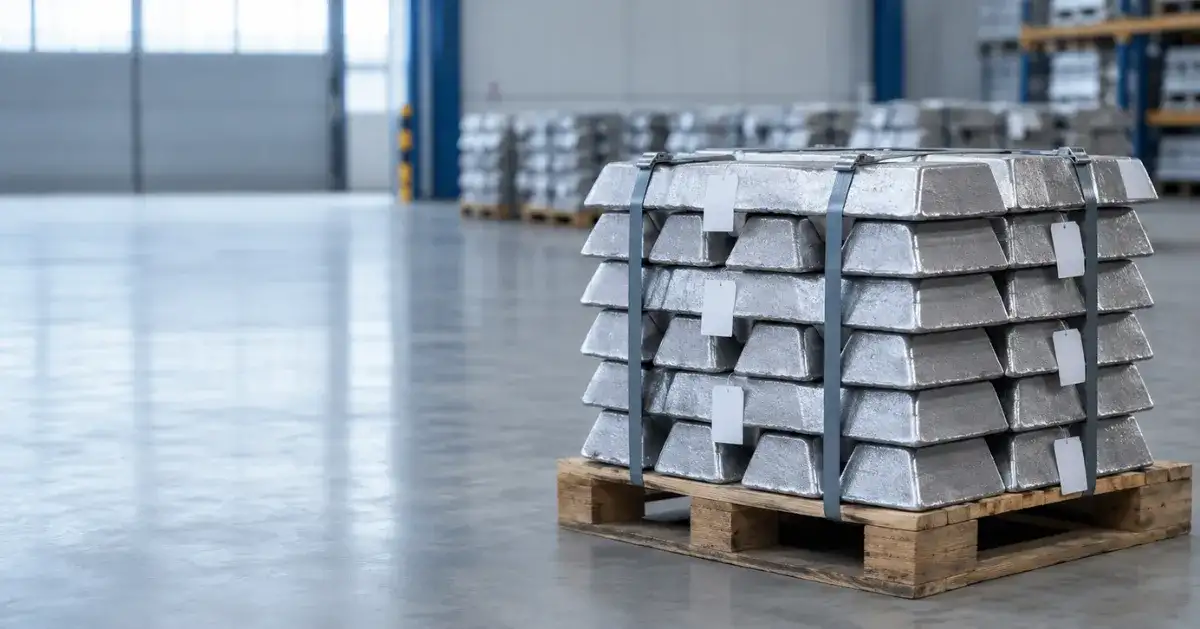
Choosing an antimony ingot supplier based on price alone can create costly problems for your supply chain. A shipment that fails quality checks or lacks the required documentation disrupts production. But the consequences do not stop there. The capital gets tied up, and profit margins get eroded. Moreover, the savings you negotiated at the purchasing stage also vanish by the time you receive the shipment.
If you are sourcing antimony ingots in bulk, your supplier evaluation process should be much more stringent. You need evidence that the supplier can deliver the correct material, meet your documentation requirements, and support repeat orders without exposing your operation to unnecessary risk.
In this blog, we provide a seven-point checklist to qualify potential suppliers so you don't run into problems. Your exact requirements will depend on your industrial application, destination market, and purchasing standards, but these seven points will help you access consistent-quality antimony at a competitive cost.
Before requesting quotations, clearly understand the antimony your production process requires. If you leave the specification open to interpretation, suppliers will quote different antimony grades or quality levels. To do this, you must,
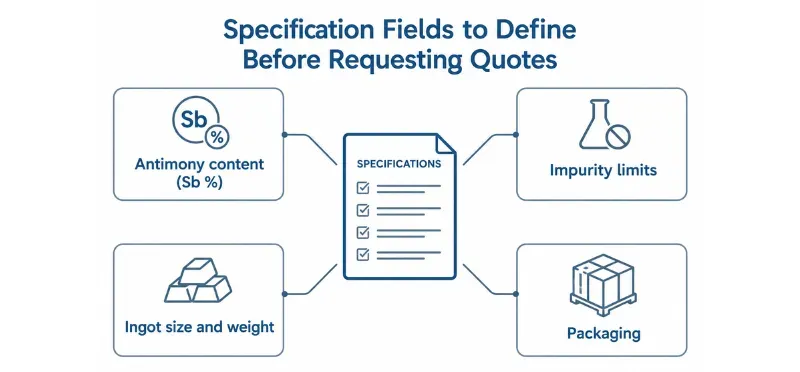
This means specifying antimony content, acceptable impurity limits, and material grade. Also mention ingot dimensions and packaging requirements. If your application needs non-standard dimensions or packaging, ask whether the supplier offers customized antimony ingots. Your industrial application determines which properties matter most. Involve your technical and quality teams before finalizing the specification. Do not assume that two suppliers offering the same general grade will deliver material with identical composition or performance.
|
Antimony purity grades |
Typical stated purity |
Common procurement considerations |
|
Commercial / standard grade |
Around 99.5% |
Confirm impurity limits; suitability depends on the end use and buyer specification. |
|
High-purity grade |
Around 99.65%–99.70% |
Request batch-specific chemical analysis and verify key impurity limits. |
|
High-purity / specialty grade |
99.9% or higher |
Confirm the exact assay method, impurity profile, and any application-specific requirements. |
Note: Grade names and purity thresholds vary. Suppliers may use different designations, so compare the written chemical specification and lot-specific certificate of analysis rather than relying on the grade label alone.
For a closer look at how grade affects buying decisions, read why antimony purity levels matter for buyers.
This step involves specifying the analytical methods, sample collection, and the test results that will determine whether a shipment passes inspection. If you require independent laboratory testing, establish that requirement before negotiating the order.
The procurement team responsible for sourcing antimony should agree internally on a uniform testing standard and quality assessment methods for determining antimony quality. Resolving these questions before a purchase prevents disagreements after the shipment reaches your facility.
Unclear specifications increase the risk of rejected material, reprocessing, and production delays. Precise specifications help you compare equivalent offers and calculate the cost of material that meets your requirements.
Once your antimony specification sheet is ready, determine whether the supplier can consistently meet your internal standards.
First, confirm if you are dealing directly with a producer, smelter, refiner, or trader. A couple of questions, such as where the ingots are produced and which organization tests and releases each batch, should be enough to identify the type of supplier you are dealing with. If the supplier relies on third parties, ask how it verifies quality and handles issues when a shipment fails inspection.
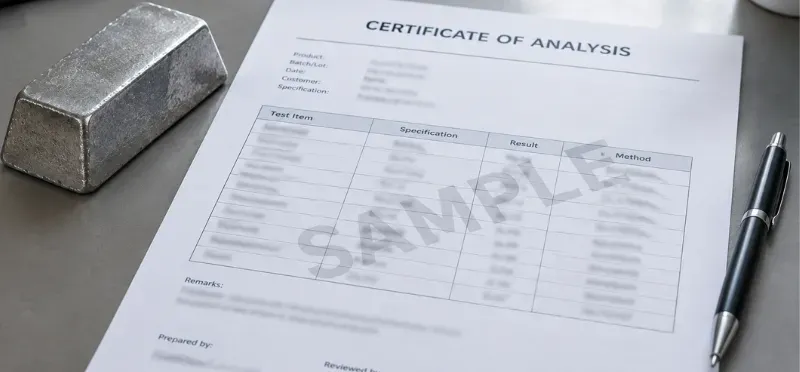
Next, examine the supplier's quality-control process. Request sample certificates of analysis (COAs). Inquire about relevant testing procedures and examples of lot-specific records. A sample COA shows the type of information the supplier provides, but it does not prove that your shipment will meet the same specification. You need documentation tied to the actual batch being supplied.
Ask how the supplier handles out-of-specification material. Does it isolate the affected batch and arrange a replacement, or does it follow a different procedure? As a sourcing professional, you need to understand this process before a quality problem threatens your production schedule.
For bulk order volumes, also keep a record of repeat-order performance. This means verifying that the antimony supplier can support your expected purchasing volumes while maintaining the same quality standard batch after batch. More importantly, confirm whether the supplier delivers on time.
These checks help you distinguish a supplier with a credible quality system from one relying on false marketing claims.
Certifications are another factor to check when you are buying antimony in bulk. They support supplier qualification, but only when they are genuine and relevant to the actual facility involved in your purchase. A document displayed on a website is not sufficient evidence on its own.
To confirm supplier credentials and authenticity, take several measures: request copies of applicable certificates and verify the issuing organization, certificate number, validity period, scope, and covered facility. Also, confirm that the certified company matches the legal entity you intend to contract with and that the certificate covers the relevant production or processing activities.
If a supplier claims certification that you cannot independently verify, resolve the discrepancy. Contact the issuing organization or consult its official verification records where available.
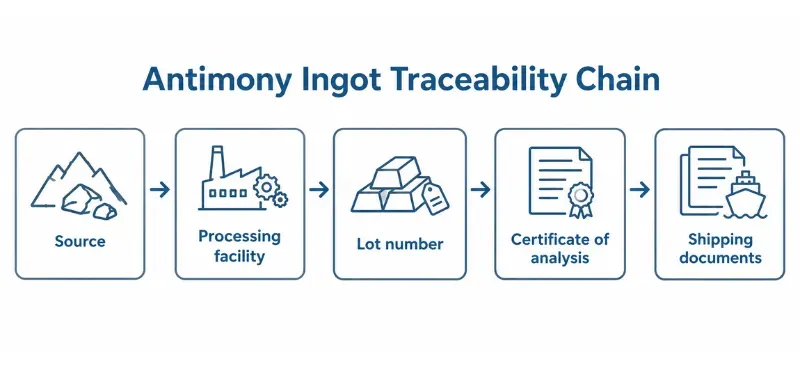
Also check the supplier's traceability system. Ask them to show how the material's source, processing facility, lot number, COA, and shipping documents link together for traceability. This matters because a traceability claim is only useful if you can follow the records when investigating a quality failure or responding to a customer audit.
Keep in mind that documentation identifying the facility that refined or processed the antimony does not necessarily mean it is the source where the original material came from. If your procurement policy requires source-level transparency, request evidence that supports that claim.
Use documentation as a decision criterion, not a box-ticking exercise. Weak traceability can turn a manageable quality issue into a prolonged dispute with the supplier, so be detail-oriented here.
Before authorizing antimony shipment, confirm that the supplier covers the safety, transport, import, and product-documentation requirements relevant to your transaction. These obligations vary by destination and applicable jurisdiction.
Start the regulatory assessment by requesting a current safety data sheet (SDS). Also request product specifications and relevant shipment documentation to confirm regulatory compliance. Confirm the documents describe the material you are purchasing, not a different grade or product form.
On your side, clarify who will prepare each document and who is responsible for resolving discrepancies. Assuming the supplier, freight forwarder, and importer share the same responsibilities is a mistake because each has different responsibilities. Your task is to confirm the applicable arrangements under your contract and delivery terms.
If the antimony supplier makes broad compliance claims but cannot provide supporting documents, they're likely not genuine. When you can't establish the requirements independently, consult the relevant authorities or a qualified compliance professional.
Incomplete documentation can bottleneck your operations by delaying port clearance and complicating customer audits.
A competitive antimony metal wholesale price helps keep your sourcing operation cost-effective, but the quoted figure is only one part of your procurement decision. You need to compare what each supplier will actually cost your business once the material reaches your facility and passes acceptance checks.
Antimony prices vary. Different grades are available at different rates. Order quantity, origin, and market conditions also drive price differences. Add-on costs like delivery arrangements, payment terms, and quality-assurance requirements also affect an offer's commercial value.
To fully understand antimony bulk pricing, ask shortlisted suppliers to quote the same specification, quantity, currency, weight unit, and delivery basis.
Then proceed to calculate the total landed cost. Include add-on costs to the material price, such as freight, insurance, applicable duties, and other relevant fees, to calculate the total landed cost.
At this stage, the procurement team should also review payment terms carefully because advance payments, currency exposure, and extended settlement periods affect your cash flow.
Your price comparison should ultimately answer one question: which supplier offers the best combination of verified quality, dependable delivery, and manageable risk, since all these matter for keeping the sourcing budget under control.
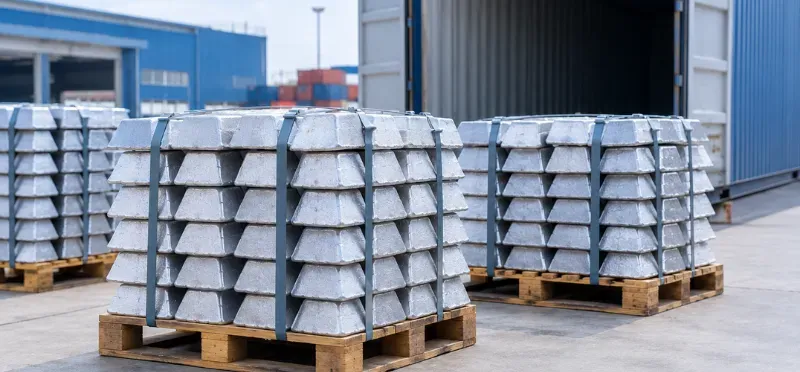
A supplier will meet your quality requirements and offer an attractive price but still create problems if it cannot deliver on schedule. Hence, before placing an order, verify that its available inventory and logistics arrangements match your factory requirements.
Confirm the quantity available for immediate shipment and the expected lead time for future orders to avoid supply problems. Sometimes the supplier depends on third parties, so ask how those relationships affect stock availability. For recurring purchases, assess whether it can support your forecast demand without repeatedly extending delivery dates. When you buy in volume, a bulk antimony ingot supplier should confirm available quantity, lead time, and batch documentation before you place an order.
For reliable delivery, the antimony supplier should also have a solid logistics plan. That means your sourcing team should have complete information on packaging requirements, shipment tracking, export documentation, and the expected arrival schedule. Make sure the supplier understands any specific receiving requirements at your facility.
Reliable logistics protect more than your delivery schedule. With clear logistics details, you can plan production and control inventory costs.
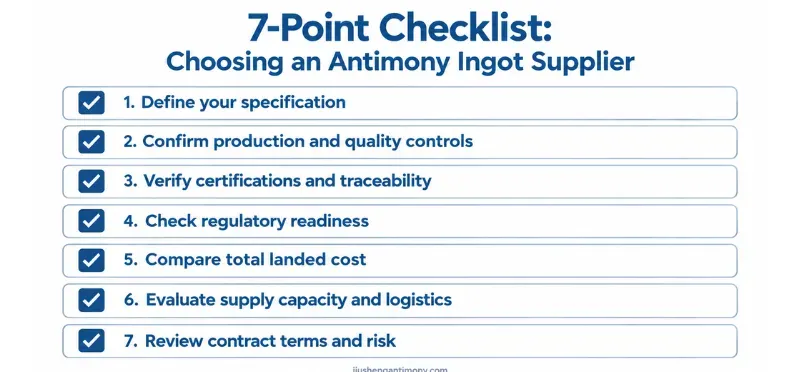
Choosing a reliable antimony ingot supplier requires evidence across the entire purchasing process. You need clear specifications, traceable documentation, and regulatory readiness. Pricing must be fully transparent, and logistics must be reliable. By applying these seven checks consistently when comparing suppliers, you can avoid most sourcing problems.
To keep your procurement budget under control, compare suppliers on the cost and risk of obtaining usable material, not just the price printed on a quotation.
If you are comparing antimony ingot suppliers, Jiu Sheng Metals can share product specifications and a sample COA on request. Send your specifications for a quotation.
The main industrial use of antimony is in flame-retardant materials. Other key antimony-based products include lead-acid batteries, metal alloys, and semiconductors. Chemically, antimony is classified as a metalloid, which explains its mix of metallic and non-metallic properties.
China is the world's leading antimony producer. Other major producers are Russia and Tajikistan.
Many bulk antimony buyers make a costly mistake: they focus on the price per ton before confirmin...
READ FULLImagine you place an antimony ingot order, and then the surprises start. The supplier says your q...
READ FULLChoosing an antimony ingot supplier based on price alone can create costly problems for your supp...
READ FULL

Have a question or need a quote? Fill out this form and our team will get back to you quickly!
