
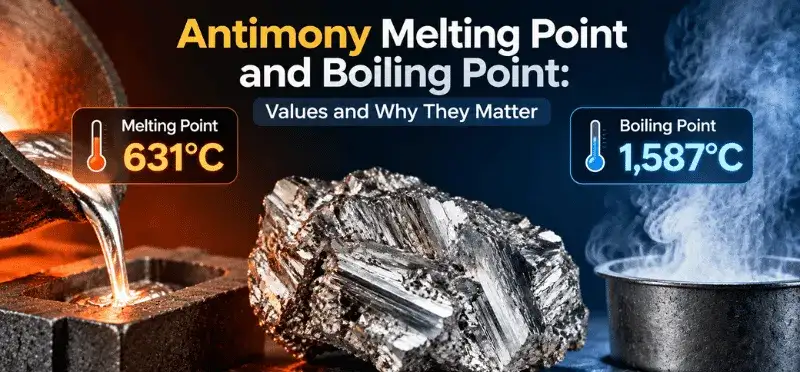
Antimony melts at 630.63 °C (1,167.13 °F, 903.78 K) and boils at about 1,587 °C (about 2,889 °F, about 1,860 K) at standard atmospheric pressure (1 atm). Antimony is one of the few substances that contracts on freezing and expands on solidifying, so it can fill molds fairly sharply. This document covers typical antimony values, why sources may vary, how antimony compares with other metals, and why these numbers matter for alloys, batteries, and safe handling. We explain the uncertainty with antimony's boiling point.
Key Takeaways
The standard atmospheric-pressure melting point of antimony is 630.63 °C (1,167.13 °F, 903.78 K). Antimony’s boiling point is about 1,587 °C (2,889 °F). Pure antimony metal has these fixed values. Antimony compounds and alloys have different melting points. Antimony trioxide is an example of an antimony compound.
The table gives the antimony melting point in Celsius, Fahrenheit, and Kelvin, plus the boiling point and liquid range at 1 atm.
|
Property |
°C |
°F |
K |
Source |
|
Melting point |
630.63 |
1,167.13 |
903.78 |
CRC Handbook; NIST |
|
Boiling point |
about 1,587 |
about 2,889 |
about 1,860 |
Varies by source |
|
Liquid range (span) |
about 956 |
about 1,721 |
about 956 |
Calculated |
Conversions: K = °C + 273.15; °F = (°C × 9/5) + 32. The liquid range is a span, so its °C and K values match.
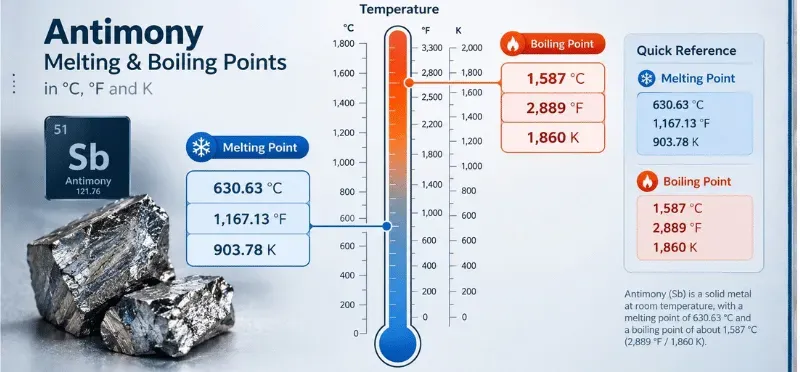
Rounding explains the differences between reported melting ranges of 630.63 °C, 630.6 °C, and 631 °C. Other factors include antimony purity and the methodology used. Trace impurities can broaden and lower the antimony melting range. Results can also depend on the technique and may differ based on the temperature scale used. For more on grades, see why antimony purity levels matter for buyers.
The boiling point is difficult to specify. Most literature reports 1,600 °C, but antimony oxidizes and fumes long before it boils. Methods can also vary. For more authoritative sources on antimony's melting and boiling points, consult the CRC Handbook (state the edition) and cross-check with the NIST Chemistry WebBook and PubChem.
Antimony (Sb) is in group 15 between arsenic and bismuth. It has a gray, silvery, metallic appearance and relatively poor thermal and electrical conductivity. Its atoms take on a layered rhombohedral structure. Its main ore is stibnite (Sb₂S₃), and the metal is called antimony metal.
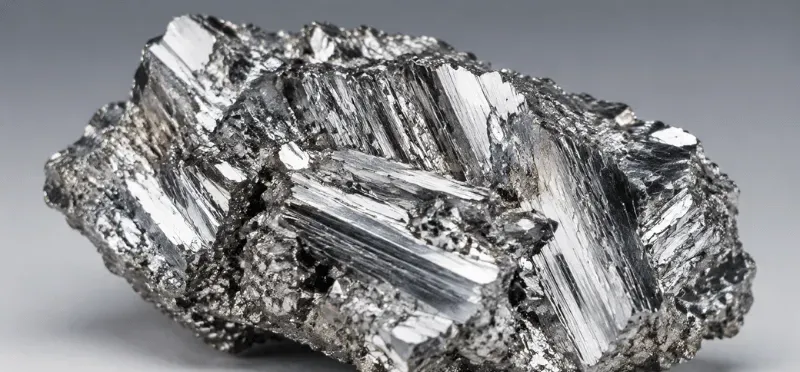
Important physical properties of antimony:
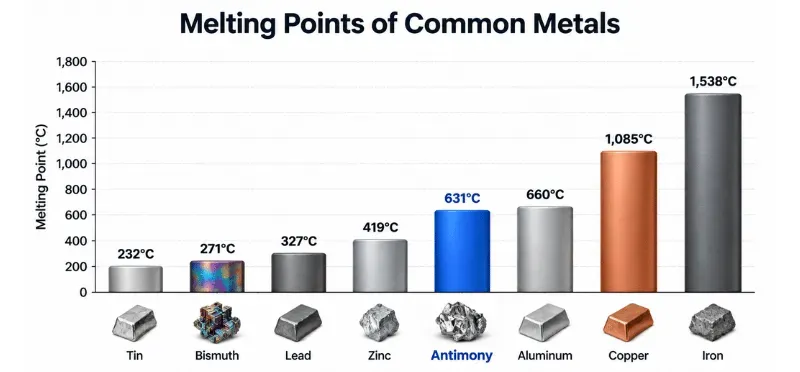
Why is antimony's melting point so much lower than copper's and iron's? 630.63 °C rounds to 631 °C, the temperature at which copper melts, compared with iron’s melting point of 1,538 °C. These metals have strong, interlocking, metallic bonding, in which the atoms are surrounded by a “sea” of electrons.
Antimony, by contrast, has more layered bonding and more covalent bonding between layers; hence, it is brittle and has a lower melting point. Each atom bonds to three neighbors in the same plane, and the layers are weakly bonded to each other.
The neighbors in Antimony’s Group 15 further illustrate this change in bonding. Arsenic sublimes near 614 to 615 °C, going straight from a solid to a gas. Antimony melts at a lower temperature, 630.63 °C. The most metallic of the three, bismuth, has a much lower melting point at 271.4 °C.
Antimony increases in volume by about 1% when it freezes because its crystal structure is relatively open. Water, bismuth, gallium, silicon, and germanium also show this unusual expansion.
Most metals shrink during solidification, leaving gaps and rounded edges. Antimony, however, expands outward. Indeed, antimony alloyed with other metals offsets some of their shrinkage. The final effect depends on the alloy's overall composition.
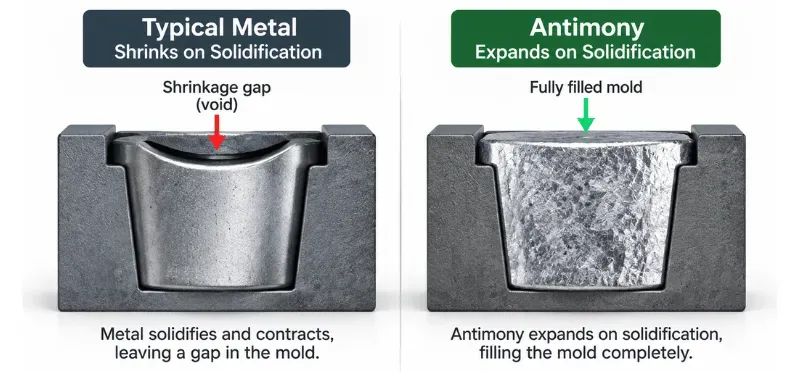
Type metal, used in the printing trade for casting characters, is an alloy of lead, tin, and antimony. Pure lead is too soft and shrinks too much to be suitable. Antimony hardens the alloy and lets it fill the mold completely, producing letters of the desired form. Antimony-hardened type metal is typically associated with earlier generations of European printing.
Antimony falls in the middle range of melting points for common metals, melting well above tin and lead but below aluminum, copper, and iron.
|
Metal |
Melting point (°C) |
Boiling point (°C) |
|
Tin |
231.9 |
~2,602 |
|
Bismuth |
271.4 |
~1,564 |
|
Lead |
327.5 |
~1,749 |
|
Zinc |
419.5 |
~907 |
|
Antimony |
630.6 |
~1,587 |
|
Aluminum |
660.3 |
~2,470 |
|
Copper |
1,085 |
~2,562 |
|
Iron |
1,538 |
~2,862 |
Boiling points are approximate and vary by source.
Antimony Trioxide (Sb₂O₃) melts at about 656 °C and boils at about 1425 °C. The metal behaves quite differently.
Stibnite (Sb₂S₃) is the most important antimony ore. The sulfide melts at about 550 °C, and Antimony metal melts at 630.63 °C.
Lead-Antimony alloys have a eutectic at 252 °C at 11% Antimony (much lower than the melting points of Pure lead at 327.5 °C and Pure Antimony at 630.63 °C. Antimony alloys generally have a lower melting point as lead content increases.
ASTM standards define Babbitt metal containing antimony. Melting ranges differ between grades.
Antimony and its compounds are not interchangeable.
Safety note: Molten metal causes severe burns, and antimony fumes and dust are toxic. This is general information only. Consult the safety data sheet (SDS) and OSHA and NIOSH guidance before heating any antimony material.
At standard pressure, antimony melts at 630.63°C (1167.13°F, 903.78K). The value is usually given as 631°C. Antimony melts at different temperatures depending on the other elements it is combined with. Antimony penta- or tri-sulfides are alloys; therefore, melting-point data for antimony alloys help determine the temperature at which antimony melts within the alloy.
The best literature reports the boiling point of antimony as approximately 1,587°C (2889°F; approximately 1860 K). Antimony's boiling point is difficult to determine experimentally, so sources report slightly different values. Antimony boils over a temperature range of about 956°C.
Although antimony has some metallic qualities, it is considered a metalloid. Antimony is brittle and has extremely poor conductivity compared to other metals. It is fairly reactive and is used in many alloy systems. Antimony has properties comparable to elemental arsenic and bismuth.
Yes. Antimony expands when it solidifies (approximately 1%). Gallium and bismuth show this characteristic as well. The expansion of a metalloid alloy when it freezes can help fill a mold during alloy fabrication.
Antimony trioxide (Sb₂O₃) melts at about 1213 °F (656 °C) and boils at about 2534 °F (1425 °C). Antimony trioxide is a different compound than antimony metal. Antimony metal melts at approximately 1230 °F (630.63 °C). Do not substitute antimony trioxide’s melt point for antimony metal in a lab report or plan.
Lead is a soft metal, and antimony strengthens it. Antimony reduces lead’s shrinkage and improves casting detail. Lead-antimony alloys are used in type metal and battery grids. Antimony isn't completely soluble in lead and has its own eutectic melt point at about 483 °F (252 °C).
You can melt antimony at home, but it's more dangerous than melting tin or lead. Antimony melts at 1230 °F (631 °C) and forms oxides that irritate the lungs. Work outside and use proper protection.
Yes, heated antimony can be hazardous because it can release toxic fumes and irritate the lungs. Antimony and its compounds are toxic if swallowed or inhaled. Vaporized antimony forms oxides. Use a fume hood and appropriate protection, and read the safety data sheet.
Antimony falls between the three elements. Arsenic is on the lower end, and bismuth is on the upper end. Arsenic sublimes, meaning it changes from solid to gas without first melting, at approximately 1130 °F (614 °C) to 1132 °F (615 °C). Bismuth melts at 448 °F (236.4 °C), and antimony melts at approximately 1230 °F (630.63 °C).
Antimony has high thermal stability and low melt viscosity compared to other metals, especially in the ~956 °C melt range. Antimony boils at 1587 °C, so it loses little material during manufacturing. Because antimony has a low melting point compared to other metals and expands by 1% during solidification, antimony castings are fully dense. Liquid antimony is easy to machine. Because of its low melting point and wide liquid range, handle antimony with proper ventilation and remove fumes and dross.
We can develop engineering specifications for antimony as needed. Contact us with your requirements. In the absence of such requirements, the information provided herein should be of value.
Many bulk antimony buyers make a costly mistake: they focus on the price per ton before confirmin...
READ FULLImagine you place an antimony ingot order, and then the surprises start. The supplier says your q...
READ FULLChoosing an antimony ingot supplier based on price alone can create costly problems for your supp...
READ FULL

Have a question or need a quote? Fill out this form and our team will get back to you quickly!
