
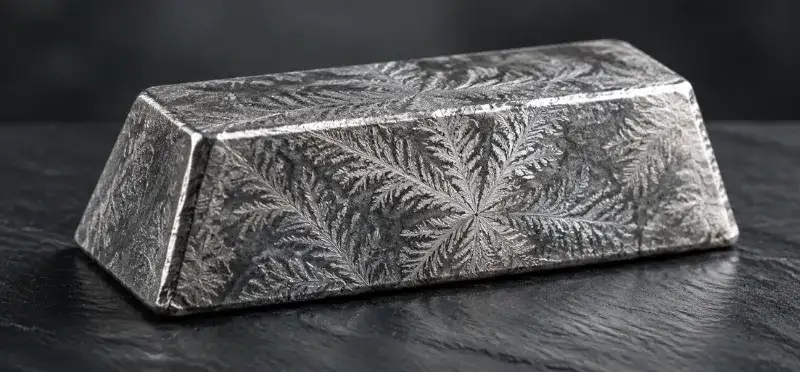
At first glance, antimony appears to have all the qualities of a metal. It has a silvery appearance, occurs as a solid, and has been used in alloys for centuries. But its behavior does not fit neatly into the usual definition of a metal.
So, is antimony a metal? Not exactly. Antimony is generally classified as a metalloid, a group of elements that sits between metals and nonmetals in the Periodic Table in terms of their properties.
That difference becomes important when you are sourcing from a bulk antimony ingot supplier or evaluating antimony for industrial, electronic, or material applications. This classification gives you the clarity to make the initial decision. However, you still need to consider the actual form and physical properties to determine its suitability for a specific industrial application.
Antimony is generally classified as a metalloid, rather than a true metal.
A metalloid has a mixture of metallic and nonmetallic characteristics. Antimony displays these characteristics clearly. It has a metallic-looking appearance and can contribute useful properties when combined with other materials. But two qualities limit its usefulness, it is brittle and does not conduct electricity as effectively as metals such as copper or aluminum.
So, calling antimony simply a metal is wrong. In scientific references, it is normally placed in the metalloid category.
Metalloids occupy the middle ground between metals and nonmetals.
They share certain characteristics with metals, such as a metallic appearance or the ability to conduct electricity under certain conditions. However, at the same time, antimony shows nonmetal-like behavior, including brittleness and relatively limited electrical conductivity.
This is why the classification is useful.

Antimony has the chemical symbol Sb and atomic number 51. It belongs to Group 15 of the periodic table.
Its position is close to the boundary commonly associated with metalloids. This location helps explain why its characteristics sit between conventional metallic and nonmetallic behavior.
However, the periodic table position should be treated as a classification guide. It is not a complete description of how antimony will behave in every application. Material properties change if the form of the element changes. So, antimony in melted form will behave differently than in a solid state.
That is an important distinction for anyone evaluating antimony for manufacturing or material selection.
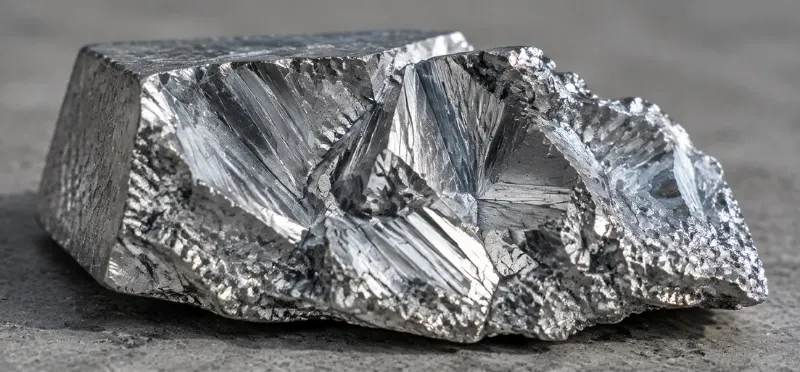
Antimony's physical and electrical properties explain its classification better than its appearance alone.
It has a silvery, lustrous appearance, which can make it look distinctly metallic. But antimony is also brittle. Unlike many common metals that are malleable and can be shaped, drawn, or rolled without breaking, antimony is not capable of that.
Its electrical conductivity also does not match what you would normally expect from a good conducting metal. This behavior is one of the reasons antimony is categorized as a metalloid.
Its properties can also vary depending on its form and conditions. So, when assessing antimony for a particular application, avoid relying on the broad label "metalloid" alone. The relevant physical and chemical characteristics need to match the requirements of the application.
A simple comparison makes its position clearer.
|
Property |
Metals |
Antimony |
Nonmetals |
|
Appearance |
Often shiny |
Shiny and silver-gray |
Often dull |
|
Strength and shape |
Many are strong and can be shaped |
Hard but brittle |
Often brittle |
|
Electrical flow |
Usually conduct electricity well |
Conducts less than most metals |
Usually poor conductors |
|
Overall behavior |
Mostly metallic |
Shows both metal and nonmetal traits |
Mostly nonmetallic |
The important point is that antimony shares characteristics with both sides.
Its appearance and some of its material behavior resemble metals. Its brittleness and comparatively limited conductivity distinguish it from many conventional metals. That combination is what makes the metalloid classification more appropriate.
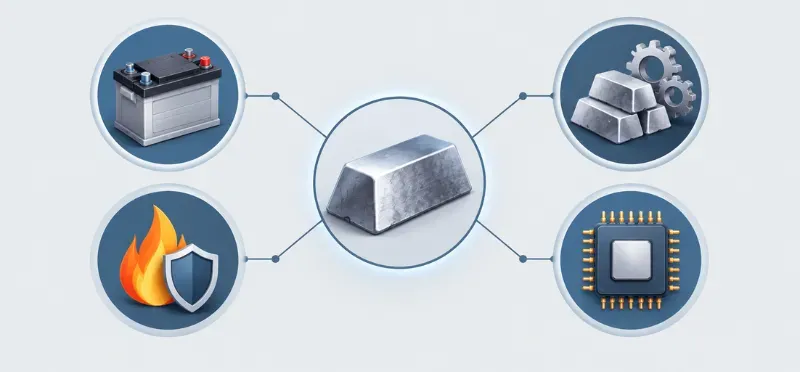
|
Industrial application |
How antimony is used |
Why it matters |
|
Lead-acid batteries |
Added to lead alloys used in battery grids and other components |
Improves the mechanical strength and casting characteristics of lead alloys |
|
Flame-retardant materials |
Antimony compounds, particularly antimony trioxide, are used with halogen-containing flame-retardant systems |
Helps improve flame resistance in plastics, textiles, coatings, and other materials |
|
Metal alloys |
Added to lead, tin, and other alloys |
Can improve hardness, strength, wear resistance, or casting performance |
|
Electronics and semiconductors |
Used in certain semiconductor materials and electronic applications |
Its electrical and semiconductor properties make it useful in specialized electronic components |
|
Solders |
Used in some lead-based and specialty solder alloys |
Can modify alloy properties and improve mechanical performance |
|
Ammunition and military alloys |
Used in certain lead-based alloys |
Helps modify hardness and mechanical properties |
|
Glass and ceramics |
Antimony compounds can be used in specialized glass and ceramic formulations |
Can contribute to refining, coloring, or other material-processing functions depending on the formulation |
|
Plastics and synthetic materials |
Antimony compounds are incorporated into some polymer systems, particularly flame-retardant formulations |
Helps manufacturers meet required fire-performance characteristics |
So, is antimony a metal? The most accurate answer is no. Antimony is generally classified as a metalloid.
Its silvery appearance gives it a distinctly metallic look, while its brittleness and electrical behavior separate it from typical metals. Its position on the periodic table also places it near the dividing line between metallic and nonmetallic elements.
For practical applications, that classification provides useful context, but it should not be the only consideration. At Jiu Sheng Metals, we see that antimony's actual properties, form, and intended use determine its value in alloys, flame-retardant materials, electronics, and other applications.
Need antimony ingots for your application? Request a quote and our team will share purity details, samples, and delivery information.
Yes, antimony can conduct electricity, but it does not behave like a highly conductive metal such as copper. Its electrical behavior is one of the characteristics that helps place it between conventional metals and nonmetals.
It can look metallic because it has a silvery, lustrous appearance. However, in scientific classification, antimony is generally described as a metalloid rather than a conventional metal.
Many bulk antimony buyers make a costly mistake: they focus on the price per ton before confirmin...
READ FULLImagine you place an antimony ingot order, and then the surprises start. The supplier says your q...
READ FULLChoosing an antimony ingot supplier based on price alone can create costly problems for your supp...
READ FULL

Have a question or need a quote? Fill out this form and our team will get back to you quickly!
